
News
Safety before Speed: The Fight for Safer Roads
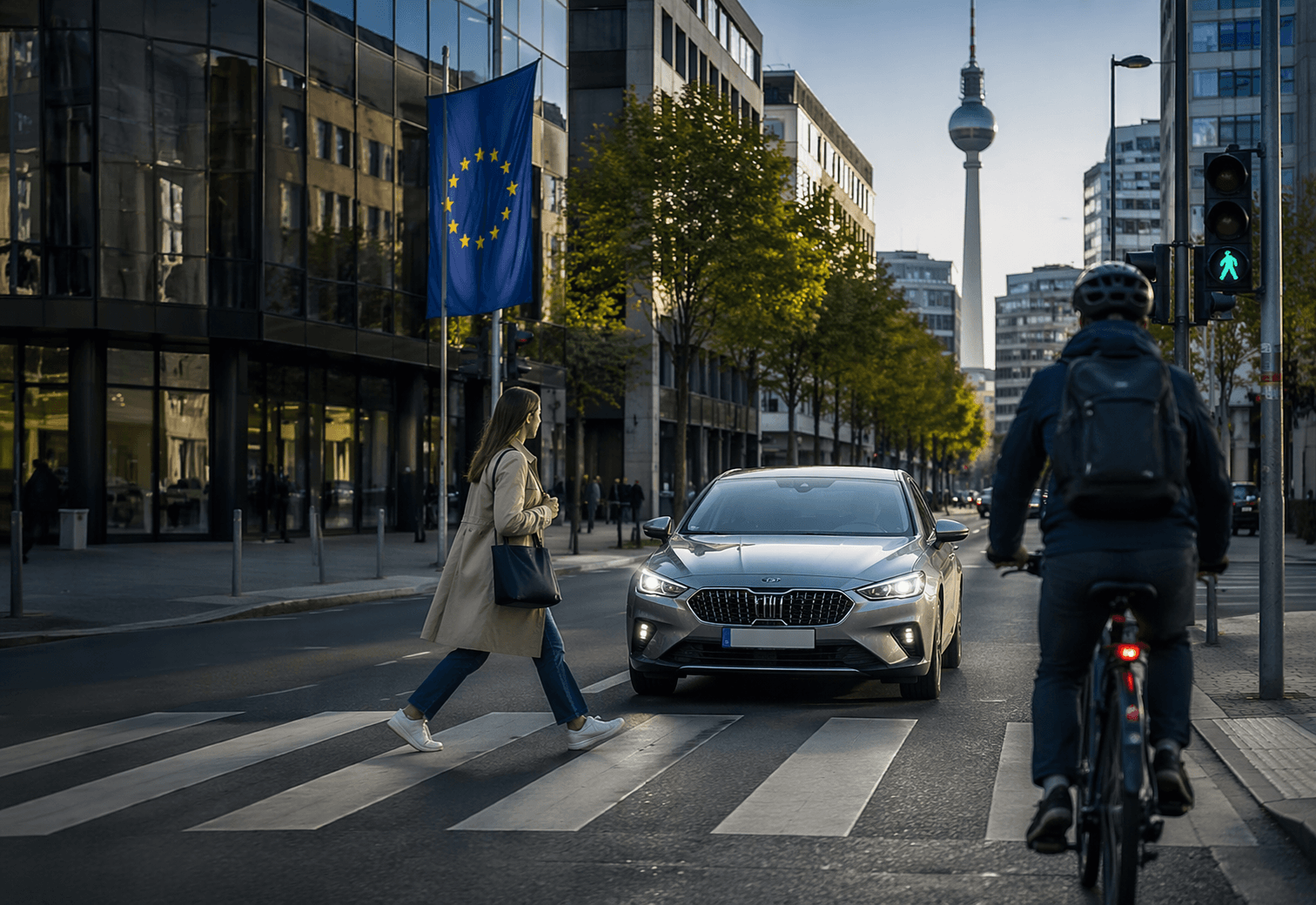
From 7 July 2026, the EU tightens what new vehicles must do to protect pedestrians and cyclists – and quietly reshapes questions of liability and insurance along the way.
A new milestone in European road-safety law arrives on 7 July 2026. From that date, the next phase of the General Safety Regulation (Regulation (EU) 2019/2144) requires new cars and light commercial vehicles to detect pedestrians and cyclists and to brake automatically where a collision threatens. It reads like an engineering update. For transport and insurance lawyers, it is rather more.
Not the starting point – the sharp end
The 2026 stage is not where these rules begin: most assistance obligations have applied since July 2024. What is new now is the focus on those most at risk – extended autonomous emergency braking for pedestrians and cyclists, plus an advanced driver distraction warning. One misconception is worth clearing up straight away: these duties flow from the General Safety Regulation, not from the Fourth Driving Licence Directive (EU) 2025/2205 adopted around the same time. The two are routinely confused – with consequences for anyone citing the wrong instrument.
Where it gets interesting for lawyers
As cycling grows, so does the litigation around it. One question keeps returning: is an e-bike a “motor vehicle”? The Court of Justice gave a clear answer in 2023 (C-286/22) – with direct effects on compulsory insurance and accident liability. The line it drew is sharper than many assume, and it does not always match national registration rules. Meanwhile, cities are moving in parallel: Brussels bans rental e-scooters from January 2027, and Paris, Madrid and Prague have already pulled them. Yet these are municipal decisions, not EU law – a distinction that carries real weight in cross-border advice.
|
Inside the full analysis in the member area
→ The four phases of the GSR II (2022 / 2024 / 2026 / 2029) – and exactly what becomes mandatory, and when → Why Directive (EU) 2025/2205 is not the legal basis – and what it actually governs → The CJEU pedelec ruling (C-286/22) and its fallout for motor third-party liability insurance → EU-law versus national classification – where speed pedelecs part ways from the directive → Heavy vehicles: the separate turning- and blind-spot-assistance duties for buses and trucks → The two-level logic – EU-wide vehicle rules against local micromobility bans – and why it matters for liability → Full case-law table and register of legal acts, each linked to its official source |